Wednesday, January 1, 2020

peleg

Continental Drift

  ‘Peleg: for in his days was the earth divided’. Why didn’t the author of the Bible use ‘nations’. The first and main meaning of the Hebrew word arez [or erets] is land, earth not nation.
 Peleg’s grandfather was Salah and it means ‘send, scatter, make somebody to flee … ’ Might be that the scattering of the people happened when Salah was born. It was 37 years after the Flood. They had actually 64 years to go to their ordered territories by God before the continental drifts.

//////////////
https://creation.com/in-pelegs-days-the-earth-was-divided


CUSH IS LUGALBANDA


he First Dynasty of Uruk may now be restored as follows, beginning with Cush (Lugal-banda).

 
 lugal banda  , cush 
 
Names of Kings 
Lengths of Reign 
Dates 
Lugal-banda (Cush)
(60)
2254-2194
Dumu-zi (Nimrod or Tammuz)
100
2194-2094
Gilgamesh (Horus or Ninyas)
126
2094-1968
Ur-lugal (Amraphel) dies in Abram's year 78)
30
1968-1938
Utul-kalamma
15
1938-1923
Labasher
9
1923-1914
En-nun-dara-anna
8
1914-1906
Meshede
36
1906-1870
Melam-anna
6
1870-1864
Lugal-ki-dul
36
1864-1828
////////////////////////////////
http://www.cgca.net/coglinks/wcglit/hoehcompendium/hhc1ch10.htm
//////////////////////////////////


//////////////////
http://www.cgca.net/coglinks/wcglit/hoehcompendium/hhc1ch10.htm
/////////////////////

COMPENDIUM OF WORLD HISTORY

COMPENDIUM OF WORLD HISTORY

VOLUME 1


A Dissertation
Presented to
The Faculty of the Ambassador College
Graduate School of Theology
In Partial Fulfillment
of the Requirements for the Degree
Doctor of Theology
by Herman L. Hoeh
1962
(1963-1965, 1967 Edition)

TABLE OF CONTENTS

Chapter One ..... The Modern Interpretation of History A Radical New View How History Is Written Not Without Bias A Case History "Anything but Historical Truth" History Involves Interpretation The Truth about the "Historical Method" Evidence of God Rejected as "Myth" History Cut from Its Moorings
Chapter Two ..... 6000 Years of History It Is Never Safe to Assume No "Prehistory" of Man Cultures, Not "Ages" Origin of the Study of History Historians Follow the Higher Critics Framework of History Founded on Egypt Is Egyptian History Correct? Distorting History
Chapter Three ..... History Begins at Babel History Corroborates the Bible On To Egypt The Chronology of Dynasty I Shem in Egypt Dynasty II of Thinis Joseph and the Seven Years' Famine The Exodus Pharaoh of the Exodus Dynasty IV -- The Pyramid Builders
Chapter Four ..... The Missing Half of Egypt's History The Story Unfolds Moses the General History of Upper Egypt The Great Theban Dynasty XII Who Was Rameses?
Chapter Five ..... Egypt After the Exodus Who Were the Invaders? The Great Shepherds Hyksos in Book of Sothis Amalekites after 1076
Chapter Six ..... The Revival of Egypt Dynasty XVIII The Biblical Parallel Shishak Captures Jerusalem Who Was Zerah the Ethiopian? Dynasty XVIII in Manetho The Book of Sothis
Chapter Seven ..... The Era of Confusion Egypt As It Really Was The Later Eighteenth Dynasty Manetho's Evidence The El-Amarna Letters Are the "Habiru" Hebrews? After El-Amarna
Chapter Eight ..... Egypt to the Persian Conquest The "Israel" Inscription The "Thirteen Fatal Years" Nebuchadnezzar and Ramesses the Great Catching Up Loose Ends Dynasty XXV, the Ethiopians Dynasty XXVI of Sais Manetho's Account of Dynasty XXVI Book of Sothis and Dynasty XXVI Another Look at the Book of Sothis Appearance of Dynasty XXIV of Sais Who Was Usimare Piankhi? Dynasty XXIII of Tanis Dynasty XXII of Bubastis So-called Dynasty XXII Dynasty XXI of Tanis What Eratosthenes Revealed
Chapter Nine ..... The Eclipse of Egypt Answer in Ezekiel Persian Kings of Egypt Egypt Rebels And Now Dynasty XX of Thebes
Chapter Ten ..... It Began at Babel Mesopotamia Rediscovered What Archaeologists Learned Analyzing the Sumerian King List History Continues at Erech
Chapter Eleven ..... Berossus and Babylonian History Another Account of Earliest Dynasties First Dynasty of Ur and Successors Now Sargon of Akkad Dynasties IV and V of Erech The Guti Dynasty Three Other Dynasties Dynasty III of Ur Dynasty of Isin Dynasty IV of Kish and the "400 Years" Dynasty of Akshak Dates of Queen Ku-Baba
Chapter Twelve ..... Hammurabi to the Fall of Babylon Why Hammurabi Dated Early The Dynasty of Larsa When Did Hammurabi Reign Damiq-ilishu Reappears' Nebuchadnezzar the First Era of Nabonassar Three Succeeding Dynasties
Chapter Thirteen ..... History of Assyria Later Assyrian Kings Who Was Shalmaneser? Predecessors of Shalmaneser III King Pul and the Bible Tiglath-pileser I and Thutmose III
Chapter Fourteen ..... History of Assyria Concluded The Kassite Dynasty The Earliest Kassites The First 1000 Years of Assyrian History Analyzing the King List
Chapter Fifteen ..... Media, India, Japan and China The Revolts of the Medes History of Early India Early Indian Kings of Magadha Scythia and the History of Japan History of China
Chapter Sixteen ..... Asia Minor and the West Modern Mythology Beginnings of History The Proof of Language The Proof of Race The Kingdom of Mitanni and the Hurrians Who Were the Hurrians? Phrygians and Hatti
Chapter Seventeen ..... How Greek History Was Corrupted Greeks Admit Homer Was Demented The Plot Centers on Troy Homer and the Lydian Kings Restoring Greek History Kings of Corinth The History of Athens The History of Sicyon Enter Sparta Who Were the Heraclidae? The History of Argos Genealogy of Danaus Sea Powers of Aegean and Eastern Mediterranean The History of Italy
Chapter Eighteen ..... The History of Ireland How Confusion Arose in Irish History The First 1000 Years The Coming of the Milesians Did David Visit Ireland? Jerimiah Goes to Ireland The Milesian Kings The Throne in Scotland
Chapter Nineteen ..... Early Britain and Western Europe The Enigma Solved Early Europe The Heraclidae Kings The Trojans and Western Europe The Testimony of Archaeology
Chapter Twenty ..... The Proof of Archaeology Archaeology in the Aegean World Palestine, Syria and Archaeology The Coming of Israel into Palestine Mesopotamian Archaeology Northern Mesopotamia Egypt in Parallel
Bibliography
Volume 2
--------------------

//////////////////////////////
http://www.cgca.net/coglinks/wcglit/hoehcompendium/hhc1toc.htm
/////////////////

And the beginning of his kingdom was Babel, and Erech, and Accad, and Calneh, in the land of Shinar

Genesis 10:10
 
 
Genesis 10:10
Parallel Verses
King James Version
And the beginning of his kingdom was Babel, and Erech, and Accad, and Calneh, in the land of Shinar.
Darby Bible Translation
And the beginning of his kingdom was Babel, and Erech, and Accad, and Calneh, in the land of Shinar.
World English Bible
The beginning of his kingdom was Babel, Erech, Accad, and Calneh, in the land of Shinar.
Young's Literal Translation
And the first part of his kingdom is Babel, and Erech, and Accad, and Calneh, in the land of Shinar;
Genesis 10:10 Parallel
Commentary
King James Translators' NotesBabel: Gr. Babylon
Geneva Study Bible
And the beginning of his kingdom was Babel, and Erech, and Accad, and Calneh, in the land of {g} Shinar.
(g) For there was another city in Egypt, called Babel.Genesis 10:10 Parallel Commentaries
Library
Healing a Phoenician Woman's Daughter. (Region of Tyre and Sidon.) ^A Matt. XV. 22-28; ^B Mark VII. 24-30. ^b And he entered into a house, and would have no man know it [Jesus sought concealment for the purposes noted in the last section. He also, no doubt, desired an opportunity to impact private instruction to the twelve]; and he could not be hid. [The fame of Jesus had spread far and wide, and he and his disciples were too well known to escape the notice of any who had seen them or heard them described.] 25 But { ^a 22 And} behold, J. W. McGarvey—The Four-Fold GospelThe Sea of SodomThe bounds of Judea, on both sides, are the sea; the western bound is the Mediterranean,--the eastern, the Dead sea, or the sea of Sodom. This the Jewish writers every where call, which you may not so properly interpret here, "the salt sea," as "the bituminous sea." In which sense word for word, "Sodom's salt," but properly "Sodom's bitumen," doth very frequently occur among them. The use of it was in the holy incense. They mingled 'bitumen,' 'the amber of Jordan,' and [an herb known to few], with John Lightfoot—From the Talmud and Hebraica
Syria at the Beginning of the Egyptian ConquestSYRIA AT THE BEGINNING OF THE EGYPTIAN CONQUEST NINEVEH AND THE FIRST COSSAEAN KINGS-THE PEOPLES OF SYRIA, THEIR TOWNS, THEIR CIVILIZATION, THEIR RELIGION-PHOENICIA. The dynasty of Uruazagga-The Cossseans: their country, their gods, their conquest of Chaldaea-The first sovereigns of Assyria, and the first Cossaean Icings: Agumhakrime. The Egyptian names for Syria: Khara, Zahi, Lotanu, Kefatiu-The military highway from the Nile to the Euphrates: first section from Zalu to Gaza-The Canaanites: G. Maspero—History Of Egypt, Chaldaea, Syria, Babylonia, and Assyria, V 4
Sargon of Assyria (722-705 B. C. )SARGON AS A WARRIOR AND AS A BUILDER. The origin of Sargon II.: the revolt of Babylon, Merodach-baladan and Elam--The kingdom of Elam from the time of the first Babylonian empire; the conquest's of Shutruh-nalkunta I.; the princes of Malamir--The first encounter of Assyria and Elam, the battle of Durilu (721 B.C.)--Revolt of Syria, Iaubidi of Hamath and Hannon of Gaza--Bocchoris and the XXIVth Egyptian dynasty; the first encounter of Assyria with Egypt, the battle of Raphia (720 B.C.). Urartu G. Maspero—History Of Egypt, Chaldaea, Syria, Babylonia, and Assyria, V 7

//////////////////

 https://biblehub.com/kjv/genesis/10-10.htm
////////////////

yaphet is amenhotep

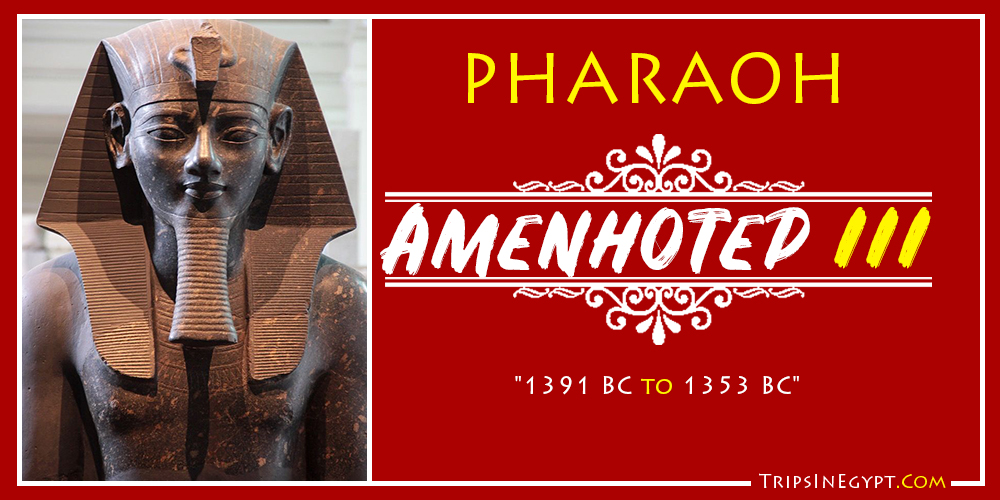
 Amenhotep III - Trips In Egypt

 Amenhotep III or as he was used to be called “Nebma’atre, Amenophis III, and Amana-Hatpa” was the 9th ruler of ancient Egypt during the 18th dynasty. All of his names are highly associated with Amun just to satisfy his deity and he was the son of Tuthmosis IV. During the reign of King Amenhotep III, Egypt reached an amazing period of prosperity & peace. He has some great achievement in the culture of Ancient Egypt that is depicted in the structures that were constructed during his reign and notably, he strengthened & expanded the borders of Egypt and that is why he is considered one of the most successful pharaohs of Ancient Egypt.
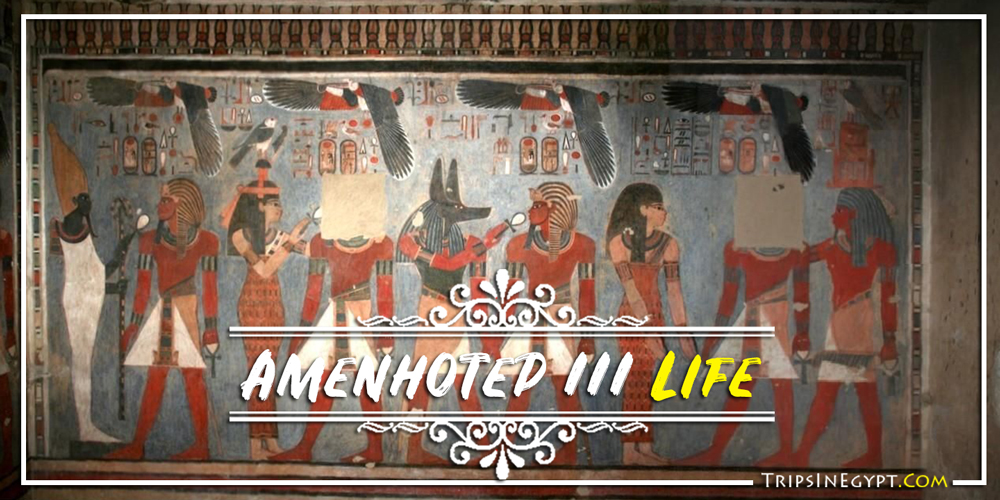
 Amenhotep III Life - Trips In Egypt


Amenhotep III has a very interesting reputation as a pharaoh as what truly distinguishes him from the other Egyptian pharaohs is that he constructed the most surviving statues, more than any other Egyptian Pharaoh, which exceed the number of 250 and they provide a series of portraits covering the whole length of his reign.
Surprisingly, from Syria to Solb in Nubia, more than 200 huge commemorative stone scarabs have been discovered and that they show the main accomplishments of the pharaoh, for instance, about 123 among those scarabs record the lions which the king has killed with his own arrow and another five, states how the princess of the king “Gilukhepa”, arrived Egypt with a retinue of 317 women.
Amenhotep III loved his wife Tiya so much and that is why he ordered his men to construct a great like for her in her town of Djakaru and Je was also rowed in the royal barge Aten-Tjehen in it. He has been crowned when he was just a child, between the ages of 6 & 12 years old and after two years, he married Tiya, who lived 12 years after his death.

//////////////////////////

 https://www.tripsinegypt.com/pharaoh-amenhotep-iii/

////////////////////////////////


Eighteenth Dynasty

Dynasties of Ancient Egypt
The Eighteenth Dynasty of ancient Egypt (notated Dynasty XVIII)[1] (c. 1550–c. 1292 BC) is perhaps the best known of all the dynasties of ancient Egypt. As well as boasting a number of Egypt's most famous pharaohs, it included Tutankhamun, the finding of whose tomb by Howard Carter in 1922 was a sensational archaeological discovery despite its having been twice disturbed by tomb robbers. The dynasty is sometimes known as the Thutmosid Dynasty because of the four pharaohs named Thutmosis (English: Thoth bore him).
As well as Tutankhamen, famous pharaohs of Dynasty XVIII include Hatshepsut (1479 BC–1458 BC), longest-reigning queen-pharaoh of an indigenous dynasty, and Akhenaten (1353–1336 BC/1351–1334 BC), the "heretic pharaoh", with his queen, Nefertiti.
Dynasty XVIII is often combined with Dynasties XIX and XX to form the New Kingdom period of ancient Egyptian history.

Dating

Radiocarbon dating suggests that Dynasty XVIII may have started a few years earlier than the conventional date of 1550 BC. The radiocarbon date range for its beginning is 1570–1544 BC, the mean point of which is 1557 BC.[2]

Dynasty XVIII pharaohs

The pharaohs of Dynasty XVIII ruled for approximately two hundred and fifty years (c. 1550–1298 BC). The dates and names in the table are taken from Dodson and Hilton.[3] Many of the pharaohs were buried in the Valley of the Kings in Thebes (designated KV). More information can be found on the Theban Mapping Project website.[4] Several diplomatic marriages are known for the New Kingdom. These daughters of foreign kings are often only mentioned in cuneiform texts and are not known from other sources. The marriages were likely a way to confirm good relations between these states.[5]
Dynasty XVIII pharaohs
Pharaoh Horus-name Reign (BC) Burial Consort(s)
Ahmose I Nebpehtire 1549–1524 BC Ahmose-Nefertari
Ahmose-Henuttamehu
Ahmose-Sitkamose
Amenhotep I Djeserkare 1524–1503 BC KV39? Ahmose-Meritamon
Thutmose I Akheperkare 1503–1493 BC KV20, KV38 Ahmose
Mutnofret
Thutmose II Akheperenre 1493–1479 BC KV42? Hatshepsut
Isis
Hatshepsut Maatkare 1479–1458 BC KV20 Thutmose II
Thutmose III Menkheper(en)re 1479–1424 BC KV34 Satiah
Merytre-Hatshepsut
Nebtu
Menhet, Menwi and Merti
Amenhotep II Akheperure 1424–1398 BC KV35 Tiaa
Thutmose IV Menkheperure 1398–1388 BC KV43 Nefertari
Iaret
Mutemwiya
Daughter of Artatama I of Mitanni
Amenhotep III Nebmaatre 1388–1350 BC KV22 Tiye
Gilukhipa of Mitanni
Tadukhipa of Mitanni
Sitamun
Iset
Daughter of Kurigalzu I of Babylon.[5]
Daughter of Kadashman-Enlil of Babylon.[5]
Daughter of Tarhundaradu of Arzawa.[5]
Daughter of the ruler of Ammia[5]
Akhenaten Neferkepherure-Waenre 1351–1334 BC Royal Tomb of Akhenaten Nefertiti
Kiya
Tadukhipa of Mitanni
Daughter of Šatiya, ruler of Enišasi[5]
meritaten?
meketaten?
Ankhesenamun
Daughter of Burna-Buriash II, King of Babylon[5]
Smenkhkare Ankhkheperure 1335–1334 BC meritaten
Neferneferuaten Ankhkheperure 1334–1332 BC Nefertiti?
Akhenaten?
Tutankhamun Nebkheperure 1332–1323 BC KV62 Ankhesenamun
Ay Kheperkheperure 1323–1319 BC KV23 Ankhesenamun
Tey
Horemheb Djeserkheperure-Setepenre 1319–1292 BC KV57 Mutnedjmet
Amenia


History of ancient Egypt

The history of Ancient Egypt spans the period from the early predynastic settlements of the northern Nile Valley to the Roman conquest in 30 BC. The Pharaonic Period is dated from around 3200 BC, when Lower and Upper Egypt became a unified state, until the country fell under Macedonian rule in 332 BC.

Contents

  • Chronology 1
  • Neolithic Egypt 2
    • Neolithic period 2.1
    • Predynastic period 2.2
  • Dynastic Egypt 3
    • Early dynastic period 3.1
    • Old Kingdom 3.2
    • First Intermediate Period 3.3
    • Middle Kingdom 3.4
    • Second Intermediate Period and the Hyksos 3.5
    • New Kingdom 3.6
      • Eighteenth Dynasty 3.6.1
      • Nineteenth Dynasty 3.6.2
      • Twentieth Dynasty 3.6.3
    • Third Intermediate Period 3.7
    • Late Period 3.8
    • Persian domination 3.9
    • Ptolemaic dynasty 3.10
  • Notes and references 4
  • Further reading 5
    • Pharaonic Egypt 5.1
    • Ptolemaic Egypt 5.2
  • External links 6

Chronology

Note
For alternative 'revisions' to the chronology of Egypt, see Egyptian chronology.
Egypt's history is split into several different periods according to the ruling dynasty of each pharaoh. The dating of events is still a subject of research. The conservative dates are not supported by any reliable absolute date for a span of about three millennia. The following is the list according to conventional Egyptian chronology.

Neolithic Egypt

Neolithic period

The Nile has been the lifeline for Egyptian culture since nomadic hunter-gatherers began living along it during the Pleistocene. Traces of these early people appear in the form of artifacts and rock carvings along the terraces of the Nile and in the oases. To the Egyptians the Nile meant life and the desert meant death, though the desert did provide them protection from invaders.
Along the Nile, in the 12th millennium BC, a grain-grinding culture using the earliest type of sickle blades had replaced the culture of hunters, fishers, and gathering people using stone tools. Evidence also indicates human habitation and cattle herding in the southwestern corner of Egypt, near the Sudan border, before 8000 BC. But according to Barbara Barich the idea of an independent bovine domestication event in Africa must be abandoned because subsequent evidence gathered over a period of thirty years has failed to corroborate this.[1] In light of this the oldest known domesticated bovine remains in Africa are from the Fayum c. 4400 BC.[2] Geological evidence and computer climate modeling studies suggest that natural climate changes around 8000 BC began to desiccate the extensive pastoral lands of northern Africa, eventually forming the Sahara (c. 2500 BC).
Continued desiccation forced the early ancestors of the Egyptians to settle around the Nile more permanently and forced them to adopt a more sedentary lifestyle. However, the period from 9000 to 6000 BC has left very little in the way of archaeological evidence.

Predynastic period

The Nile Valley of Egypt was basically uninhabitable until the work of clearing and irrigating the land along the banks of the river was started.[3] However it appears that this clearance and irrigation was largely under way by about 6000 BC. By that time, society in the Nile Valley was already engaged in organized agriculture and the construction of large buildings in the Nile Valley.[4] At this time, Egyptians in the southwestern corner of Egypt were herding cattle and also constructing large buildings. Mortar was in use by 4000 BC. The people of the Nile Valley and on delta were self-sufficient and were raising barley and emmer (an early variety of wheat) and stored it in pits lined with reed mats.[5] They raised cattle, goats and pigs and they wove linens and baskets.[5] The Predynastic Period continues through this time, variously held to begin with the Naqada culture.
Between 5500 and 3100 BC, during Egypt's Predynastic Period, small settlements flourished along the Nile, whose delta empties into the Mediterranean Sea. By 3300 BC, just before the first Egyptian dynasty, Egypt was divided into two kingdoms, known as Upper Egypt, Ta Shemau, to the south, and Lower Egypt, Ta Mehu, to the north.[6] The dividing line was drawn roughly in the area of modern Cairo.
The Tasian culture was the next to appear in Upper Egypt. This group is named for the burials found at Der Tasa, a site on the east bank of the Nile between Asyut and Akhmim. The Tasian culture group is notable for producing the earliest blacktop-ware, a type of red and brown pottery painted black on its top and interior.[7]
The Badarian Culture, named for the Badari site near Der Tasa, followed the Tasian culture, however similarities between the two have led many to avoid differentiating between them at all. The Badarian Culture continued to produce the kind of pottery called Blacktop-ware (although its quality was much improved over previous specimens), and was assigned the Sequence Dating numbers between 21 and 29.[8] The significant difference, however, between the Tasian and Badarian culture groups, which prevents scholars from completely merging the two, is that Badarian sites use copper in addition to stone, and thus are chalcolithic settlements, while the Tasian sites are still Neolithic, and are considered technically part of the Stone Age.[8]
The Amratian culture is named after the site of el-Amra, about 120 km south of Badari. El-Amra was the first site where this culture group was found unmingled with the later Gerzean culture group. However, this period is better attested at the Naqada site, and so is also referred to as the Naqada I culture.[9] Black-topped ware continued to be produced, but white cross-line ware, a type of pottery decorated with close parallel white lines crossed by another set of close parallel white lines, began to be produced during this time. The Amratian period falls between S.D. 30 and 39 in Petrie's Sequence Dating system.[10] Trade between Upper and Lower Egypt was attested at this time, as newly excavated objects indicate. A stone vase from the north was found at el-Amra, and copper, which is not present in Egypt, was apparently imported from the Sinai, or perhaps from Nubia. Obsidian[11] and an extremely small amount of gold[10] were both definitively imported from Nubia during this time. Trade with the oases was also likely.[11]
The Gerzean Culture, named after the site of Gerza, was the next stage in Egyptian cultural development, and it was during this time that the foundation for Dynastic Egypt was laid. Gerzean culture was largely an unbroken development out of Amratian Culture, starting in the delta and moving south through upper Egypt; however, it failed to dislodge Amratian Culture in Nubia.[12] Gerzean culture coincided with a significant drop in rainfall,[12] and farming produced the vast majority of food.[12] With increased food supplies, the populace adopted a much more sedentary lifestyle, and the larger settlements grew to cities of about 5,000 residents.[12] It was in this time that the city dwellers started using mud brick to build their cities.[12] Copper instead of stone was increasingly used to make tools[12] and weaponry.[13] Silver, gold, lapis, and faience were used ornamentally,[14] and the grinding palettes used for eye-paint since the Badarian period began to be adorned with relief carvings.[13]


Early Dynasty XVIII

Dynasty XVIII was founded by Ahmose I the brother or son of Kamose, the last ruler of the Dynasty XVII. Ahmose finished the campaign to expel the Hyksos rulers.His reign is seen as the end of the Second Intermediate Period and the start of New Kingdom. Ahmose was succeeded by his son, Amenhotep I whose reign was relatively uneventful.[6]
Amenhotep I probably left no male heir and the next Pharaoh, Thutmose I, seems to have been related to the royal family through marriage. During his reign the borders of Egypt's empire reached their greatest expanse, extending in the north to Carchemish on the Euphrates and up to Kurgus beyond the fourth cataract in the south. Thutmose I was succeeded by Thutmose II and his queen, Hatshepsut. She was the daughter of Thutmose I and soon after her husband's death, ruled for over twenty years after becoming pharaoh during the minority of her stepson, who later would become pharaoh as Thutmose III.
Thutmose III who later became known as the greatest military pharaoh ever, also had a lengthy reign after becoming pharaoh. He had a second co-regency in his old age with his son Amenhotep II. Amenhotep II was succeeded by Thutmose IV, who in his turn was followed by his son Amenhotep III. The reign of Amenhotep III is seen as a high point in this dynasty. Amenhotep III undertook large scale building programmes, the extent of which can only be compared with those of the much longer reign of Ramesses II during Dynasty XIX.[7]

Akhenaten, the Amarna Period and Tutankhamun

Amenhotep III may have shared the throne for up to 12 years with his son Amenhotep IV, who would change his name to Akhenaten. There is much debate about this proposed co-regency. Some experts believe there was a lengthy co-regency, while others prefer to see a short one. There are also many experts who believe no such co-regency existed at all.
In the fifth year of his reign Amenhotep IV changed his name to Akhenaten and moved his capital to Amarna. During the reign of Akhenaten the Aten—the sundisk—first became the most prominent deity, and eventually the Aten was considered the only god.[8] Whether this amounted to true monotheism continues to be the subject of debate within the academic community. Some state that Akhenaten created a monotheism while others point out that he merely suppressed a dominant solar cult by the assertion of another, while he never completely abandoned several other traditional deities.
Later Egyptians considered the so-called Amarna Period an unfortunate aberration. The events following Akhenaten's death are unclear. Individuals named Smenkhare and Neferneferuaten are known but their relative placement and role in history is still much debated. Tutankhamun eventually took the throne and died young.[9]

Ay and Horemheb

The last two members of the eighteenth dynasty—Ay and Horemheb—became rulers from the ranks of officials in the royal court, although Ay may have married the widow of Tutankhamun in order to obtain power and she did not live long afterward. Ay's reign was short. His successor was Horemheb, a general during the reign of Tutankhamun whom the childless pharaoh may have intended as his successor.[9] Horemheb may have taken the throne away from Ay in a coup. He was impotent and thus also died childless and appointed his successor, Ramesses I, who ascended the throne in 1292 BC and was the first pharaoh of the Nineteenth Dynasty.

Dynasty XVIII timeline

ImageSize = width:800 height:auto barincrement:12 PlotArea = top:10 bottom:30 right:130 left:20 AlignBars = justify
DateFormat = yyyy Period = from:-1560 till:-1290 TimeAxis = orientation:horizontal ScaleMajor = unit:year increment:100 start:-1560 ScaleMinor = unit:year increment:25 start:-1560
Colors =
 id:canvas      value:rgb(0.97,0.97,0.97)
 id:PA   value:green
 id:GP   value:red
 id:eon    value:rgb(1,0.7,1)   # light purple
Backgroundcolors = canvas:canvas
BarData =
 barset:Rulers
PlotData=
 width:5 align:left fontsize:S shift:(5,-4) anchor:till
 barset:Rulers
 from: -1550 till: -1525 color:PA text:"Ahmose I (1550–1525 BC)"
 from: -1525 till: -1504 color:PA text:"Amenhotep I (1525–1504 BC)"
 from: -1504 till: -1492 color:PA text:"Thutmose I (1504–1492 BC)"
 from: -1492 till: -1479 color:PA text:"Thutmose II (1492–1479 BC)"
 from: -1479 till: -1457 color:PA text:"Hatshepsut (1479–1457 BC)"
 from: -1479 till: -1425 color:PA text:"Thutmose III (1479–1425 BC)"
 from: -1427 till: -1401 color:PA text:"Amenhotep II" (1427–1401 BC)
 from: -1401 till: -1391 color:PA text:"Thutmose IV" (1401–1391 BC)
 from: -1391 till: -1353 color:PA text:"Amenhotep III" (1391–1353 BC)
 from: -1391 till: -1353 color:PA text:"Tiye" (?–1338 BC)
 from: -1353 till: -1335 color:PA text:"Akhenaten" (1353–1335 BC)
 from: -1336 till: -1335 color:PA text:"Smenkhkare ?" (1336–1335 BC?)
 from: -1335 till: -1333 color:PA text:"Neferneferuaten?" (1335–1333 BC?}
 from: -1333 till: -1323 color:PA text:"Tutankhamun (1333–1323 BC)"
 from: -1323 till: -1319 color:PA text:"Ay (1323–1319 BC)"
 from: -1319 till: -1292 color:PA text:"Horemheb (1319–1292 BC)"
 barset:skip

///////////////////////////////
 http://self.gutenberg.org/articles/History_of_ancient_Egypt

 http://self.gutenberg.org/articles/Eighteenth_Dynasty
//////////////////////////////////

HAM IS HAMMURABBI


Hammurabi

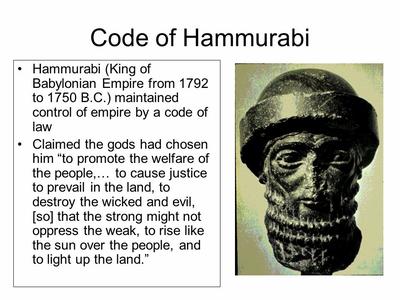
Hammurabi was the sixth king in the Babylonian dynasty, which ruled in central Mesopotamia (present-day Iraq) from c. 1894 to 1595 B.C.
/////////////////////////
The Code of Hammurabi was one of the earliest and most complete written legal codes and was proclaimed by the Babylonian king Hammurabi, who reigned from 1792 to 1750 B.C. Hammurabi expanded the city-state of Babylon along the Euphrates River to unite all of southern Mesopotamia. The Hammurabi code of laws, a collection of 282 rules, established standards for commercial interactions and set fines and punishments to meet the requirements of justice. Hammurabi’s Code was carved onto a massive, finger-shaped black stone stele (pillar) that was looted by invaders and finally rediscovered in 1901.


///////////////////////////
 https://www.history.com/topics/ancient-history/hammurabi
/////////////////////////

SHEM IS SAMSUILUNA


Strictly speaking, the use of the name “Assyria” for the period before the latter half of the 2nd millennium bce is anachronistic; Assyria—as against the city-state of Ashur—did not become an independent state until about 1400 bce.
 In contrast to southern Mesopotamia or the mid-Euphrates region (Mari), written sources in Assyria do not begin until very late, shortly before Ur III. By Assyria—a region that does not lend itself to precise geographic delineation—is understood the territory on the Tigris north of the river’s passage through the mountains of the Jabal Ḥamrīn to a point north of Nineveh, as well as the area between Little and Great Zab (a tributary of the Tigris in northeast Iraq) and to the north of the latter. In the north, Assyria was later bordered by the mountain state of Urartu; to the east and southeast its neighbour was the region around ancient Nuzi (near modern Kirkūk,

 “Arrapchitis” [Arrapkha] of the Greeks). In the early 2nd millennium the main cities of this region were Ashur (160 miles north-northwest of modern Baghdad), the capital (synonymous with the city god and national divinity); Nineveh, lying opposite modern Mosul; and Urbilum, later Arbela (modern Irbīl, some 200 miles north of Baghdad).
///////////////////////////////////////////////////
CHAPTER I—THE DISCOVERY OF PREHISTORIC EGYPT

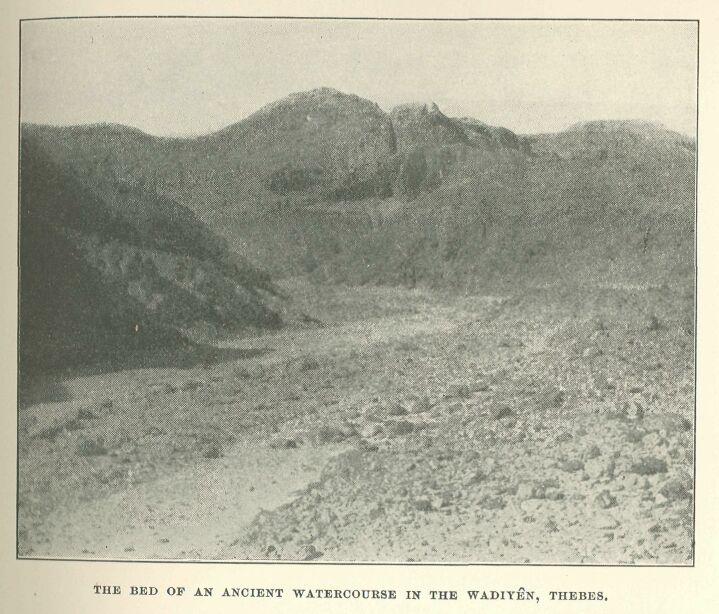
 007.jpg the Bed of an Ancient Watercourse in The Wadiyên, Thebes.

During the last ten years our conception of the beginnings of Egyptian antiquity has profoundly altered. When Prof. Maspero published the first volume of his great Histoire Ancienne des Peuples des l’Orient Classique, in 1895, Egyptian history, properly so called, still began with the Pyramid-builders, Sne-feru, Khufu, and Khafra (Cheops and Chephren), and the legendary lists of earlier kings preserved at Abydos and Sakkara were still quoted as the only source of knowledge of the time before the IVth Dynasty. Of a prehistoric Egypt nothing was known, beyond a few flint flakes gathered here and there upon the desert plateaus, which might or might not tell of an age when the ancestors of the Pyramid-builders knew only the stone tools and weapons of the primeval savage.
Now, however, the veil which has hidden the beginnings of Egyptian civilization from us has been lifted, and we see things, more or less, as they actually were, unobscured by the traditions of a later day. Until the last few years nothing of the real beginnings of history in either Egypt or Mesopotamia had been found; legend supplied the only material for the reconstruction of the earliest history of the oldest civilized nations of the globe. Nor was it seriously supposed that any relics of prehistoric Egypt or Mesopotamia ever would be found. The antiquity of the known history of these countries already appeared so great that nobody took into consideration the possibility of our discovering a prehistoric Egypt or Mesopotamia; the idea was too remote from practical work. And further, civilization in these countries had lasted so long that it seemed more than probable that all traces of their prehistoric age had long since been swept away. Yet the possibility, which seemed hardly worth a moment’s consideration in 1895, is in 1905 an assured reality, at least as far as Egypt is concerned. Prehistoric Babylonia has yet to be discovered. It is true, for example, that at Mukay-yar, the site of ancient Ur of the Chaldees, burials in earthenware coffins, in which the skeletons lie in the doubled-up position characteristic of Neolithic interments, have been found; but there is no doubt whatever that these are burials of a much later date, belonging, quite possibly, to the Parthian period. Nothing that may rightfully be termed prehistoric has yet been found in the Euphrates valley, whereas in Egypt prehistoric antiquities are now almost as well known and as well represented in our museums as are the prehistoric antiquities of Europe and America.
With the exception of a few palasoliths from the surface of the Syrian desert, near the Euphrates valley, not a single implement of the Age of Stone has yet been found in Southern Mesopotamia, whereas Egypt has yielded to us the most perfect examples of the flint-knapper’s art known, flint tools and weapons more beautiful than the finest that Europe and America can show. The reason is not far to seek. Southern Mesopotamia is an alluvial country, and the ancient cities, which doubtless mark the sites of the oldest settlements in the land, are situated in the alluvial marshy plain between the Tigris and the Euphrates; so that all traces of the Neolithic culture of the country would seem to have disappeared, buried deep beneath city-mounds, clay and marsh. It is the same in the Egyptian Delta, a similar country; and here no traces of the prehistoric culture of Egypt have been found. The attempt to find them was made last year at Buto, which is known to be one of the most antique centres of civilization, and probably was one of the earliest settlements in Egypt, but without success. The infiltration of water had made excavation impossible and had no doubt destroyed everything belonging to the most ancient settlement. It is not going too far to predict that exactly the same thing will be found by any explorer who tries to discover a Neolithic stratum beneath a city-mound of Babylonia. There is little hope that prehistoric Chaldæa will ever be known to us. But in Egypt the conditions are different. The Delta is like Babylonia, it is true; but in the Upper Nile valley the river flows down with but a thin border of alluvial land on either side, through the rocky and hilly desert, the dry Sahara, where rain falls but once in two or three years. Antiquities buried in this soil in the most remote ages are preserved intact as they were first interred, until the modern investigator comes along to look for them. And it is on the desert margin of the valley that the remains of prehistoric Egypt have been found. That is the reason for their perfect preservation till our own day, and why we know prehistoric Egypt so well.
The chief work of Egyptian civilization was the proper irrigation of the alluvial soil, the turning of marsh into cultivated fields, and the reclamation of land from the desert for the purposes of agriculture. Owing to the rainless character of the country, the only means of obtaining water for the crops is by irrigation, and where the fertilizing Nile water cannot be taken by means of canals, there cultivation ends and the desert begins. Before Egyptian civilization, properly so called, began, the valley was a great marsh through which the Nile found its way north to the sea. The half-savage, stone-using ancestors of the civilized Egyptians hunted wild fowl, crocodiles, and hippopotami in the marshy valley; but except in a few isolated settlements on convenient mounds here and there (the forerunners of the later villages), they did not live there. Their settlements were on the dry desert margin, and it was here, upon low tongues of desert hill jutting out into the plain, that they buried their dead. Their simple shallow graves were safe from the flood, and, but for the depredations of jackals and hyenas, here they have remained intact till our own day, and have yielded up to us the facts from which we have derived our knowledge of prehistoric Egypt. Thus it is that we know so much of the Egyptians of the Stone Age, while of their contemporaries in Mesopotamia we know nothing, nor is anything further likely to be discovered.
But these desert cemeteries, with their crowds of oval shallow graves, covered by only a few inches of surface soil, in which the Neolithic Egyptians lie crouched up with their flint implements and polished pottery beside them, are but monuments of the later age of prehistoric Egypt. Long before the Neolithic Egyptian hunted his game in the marshes, and here and there essayed the work of reclamation for the purposes of an incipient agriculture, a far older race inhabited the valley of the Nile. The written records of Egyptian civilization go back four thousand years before Christ, or earlier, and the Neolithic Age of Egypt must go back to a period several thousand years before that. But we can now go back much further still, to the Palaeolithic Age of Egypt. At a time when Europe was still covered by the ice and snows of the Glacial Period, and man fought as an equal, hardly yet as a superior, with cave-bear and mammoth, the Palaeolithic Egyptians lived on the banks of the Nile. Their habitat was doubtless the desert slopes, often, too, the plateaus themselves; but that they lived entirely upon the plateaus, high up above the Nile marsh, is improbable. There, it is true, we find their flint implements, the great pear-shaped weapons of the types of Chelles, St. Acheul, and Le Moustier, types well known to all who are acquainted with the flint implements of the “Drift” in Europe. And it is there that the theory, generally accepted hitherto, has placed the habitat of the makers and users of these implements.
The idea was that in Palaeolithic days, contemporary with the Glacial Age of Northern Europe and America, the climate of Egypt was entirely different from that of later times and of to-day. Instead of dry desert, the mountain plateaus bordering the Nile valley were supposed to have been then covered with forest, through which flowed countless streams to feed the river below. It was suggested that remains of these streams were to be seen in the side ravines, or wadis, of the Nile valley, which run up from the low desert on the river level into the hills on either hand. These wadis undoubtedly show extensive traces of strong water action; they curve and twist as the streams found their easiest way to the level through the softer strata, they are heaped up with great water-worn boulders, they are hollowed out where waterfalls once fell. They have the appearance of dry watercourses, exactly what any mountain burns would be were the water-supply suddenly cut off for ever, the climate altered from rainy to eternal sun-glare, and every plant and tree blasted, never to grow again. Acting on the supposition that this idea was a correct one, most observers have concluded that the climate of Egypt in remote periods was very different from the dry, rainless one now obtaining. To provide the water for the wadi streams, heavy rainfall and forests are desiderated. They were easily supplied, on the hypothesis. Forests clothed the mountain plateaus, heavy rains fell, and the water rushed down to the Nile, carving out the great watercourses which remain to this day, bearing testimony to the truth. And the flints, which the Palaeolithic inhabitants of the plateau-forests made and used, still lie on the now treeless and sun-baked desert surface.


////////////////////////////////////////////////////
 https://www.gutenberg.org/files/17321/17321-h/17321-h.htm
https://www.britannica.com/place/Mesopotamia-historical-region-Asia/Early-history-of-Assyria#ref361304
/////////////////////////////////